I uploaded the workshop paper by Prof. B.D.Rao and Prof. K.Kreutz-Delgado, which was presented in the 8th IEEE Digital Signal Processing Workshop, Bryce Canyon, UT, 1998. The workshop paper can be downloaded here.
Probably this is the first paper on the multiple measurement vector (MMV) model. As you can see, the MMV versions of FOCUSS, Matching Pursuit, Order Recursive Matching Pursuit, and Modified Matching Pursuit were all presented in this paper. These contents were fully discussed and extended in their journal paper under the same title (Sparse solutions to linear inverse problems with multiple measurement vectors). But unfortunately, the journal paper was published seven years later!!!
Monday, July 25, 2011


Thursday, July 21, 2011
Academic Software Applications for Electromagnetic Brain Mapping Using MEG and EEG

The following is the content. You will see many famous softwares are discussed in this special issue.
Academic Software Applications for Electromagnetic Brain Mapping Using MEG and EEG, Sylvain Baillet, Karl Friston, and Robert Oostenveld
Volume 2011 (2011), Article ID 972050, 4 pages
Brainstorm: A User-Friendly Application for MEG/EEG Analysis, François Tadel, Sylvain Baillet, John C. Mosher, Dimitrios Pantazis, and Richard M. Leahy
Volume 2011 (2011), Article ID 879716, 13 pages
Spatiotemporal Analysis of Multichannel EEG: CARTOOL, Denis Brunet, Micah M. Murray, and Christoph M. Michel
Volume 2011 (2011), Article ID 813870, 15 pages
EEGLAB, SIFT, NFT, BCILAB, and ERICA: New Tools for Advanced EEG Processing, Arnaud Delorme, Tim Mullen, Christian Kothe, Zeynep Akalin Acar, Nima Bigdely-Shamlo, Andrey Vankov, and Scott Makeig
Volume 2011 (2011), Article ID 130714, 12 pages
ELAN: A Software Package for Analysis and Visualization of MEG, EEG, and LFP Signals, Pierre-Emmanuel Aguera, Karim Jerbi, Anne Caclin, and Olivier Bertrand
Volume 2011 (2011), Article ID 158970, 11 pages
ElectroMagnetoEncephalography Software: Overview and Integration with Other EEG/MEG Toolboxes, Peter Peyk, Andrea De Cesarei, and Markus Junghöfer
Volume 2011 (2011), Article ID 861705, 10 pages
FieldTrip: Open Source Software for Advanced Analysis of MEG, EEG, and Invasive Electrophysiological Data, Robert Oostenveld, Pascal Fries, Eric Maris, and Jan-Mathijs Schoffelen
Volume 2011 (2011), Article ID 156869, 9 pages
MEG/EEG Source Reconstruction, Statistical Evaluation, and Visualization with NUTMEG, Sarang S. Dalal, Johanna M. Zumer, Adrian G. Guggisberg, Michael Trumpis, Daniel D. E. Wong, Kensuke Sekihara, and Srikantan S. Nagarajan
Volume 2011 (2011), Article ID 758973, 17 pages
EEG and MEG Data Analysis in SPM8, Vladimir Litvak, Jérémie Mattout, Stefan Kiebel, Christophe Phillips, Richard Henson, James Kilner, Gareth Barnes, Robert Oostenveld, Jean Daunizeau, Guillaume Flandin, Will Penny, and Karl Friston
Volume 2011 (2011), Article ID 852961, 32 pages
EEGIFT: Group Independent Component Analysis for Event-Related EEG Data, Tom Eichele, Srinivas Rachakonda, Brage Brakedal, Rune Eikeland, and Vince D. Calhoun
Volume 2011 (2011), Article ID 129365, 9 pages
LIMO EEG: A Toolbox for Hierarchical LInear MOdeling of ElectroEncephaloGraphic Data, Cyril R. Pernet, Nicolas Chauveau, Carl Gaspar, and Guillaume A. Rousselet
Volume 2011 (2011), Article ID 831409, 11 pages
Ragu: A Free Tool for the Analysis of EEG and MEG Event-Related Scalp Field Data Using Global Randomization Statistics, Thomas Koenig, Mara Kottlow, Maria Stein, and Lester Melie-García
Volume 2011 (2011), Article ID 938925, 14 pages
BioSig: The Free and Open Source Software Library for Biomedical Signal Processing, Carmen Vidaurre, Tilmann H. Sander, and Alois Schlögl
Volume 2011 (2011), Article ID 935364, 12 pages
Craniux: A LabVIEW-Based Modular Software Framework for Brain-Machine Interface Research, Alan D. Degenhart, John W. Kelly, Robin C. Ashmore, Jennifer L. Collinger, Elizabeth C. Tyler-Kabara, Douglas J. Weber, and Wei Wang
Volume 2011 (2011), Article ID 363565, 13 pages
rtMEG: A Real-Time Software Interface for
Magnetoencephalography, Gustavo Sudre, Lauri Parkkonen, Elizabeth Bock, Sylvain Baillet, Wei Wang, and Douglas J. Weber
Volume 2011 (2011), Article ID 327953, 7 pages
BrainNetVis: An Open-Access Tool to Effectively Quantify and Visualize Brain Networks, Eleni G. Christodoulou, Vangelis Sakkalis, Vassilis Tsiaras, and Ioannis G. Tollis
Volume 2011 (2011), Article ID 747290, 12 pages
fMRI Artefact Rejection and Sleep Scoring Toolbox, Yves Leclercq, Jessica Schrouff, Quentin Noirhomme, Pierre Maquet, and Christophe Phillips
Volume 2011 (2011), Article ID 598206, 11 pages
Highly Automated Dipole EStimation (HADES), C. Campi, A. Pascarella, A. Sorrentino, and M. Piana
Volume 2011 (2011), Article ID 982185, 11 pages
Forward Field Computation with OpenMEEG, Alexandre Gramfort, Théodore Papadopoulo, Emmanuel Olivi, and Maureen Clerc
Volume 2011 (2011), Article ID 923703, 13 pages
PyEEG: An Open Source Python Module for EEG/MEG Feature Extraction, Forrest Sheng Bao, Xin Liu, and Christina Zhang
Volume 2011 (2011), Article ID 406391, 7 pages
TopoToolbox: Using Sensor Topography to Calculate Psychologically Meaningful Measures from Event-Related EEG/MEG, Xing Tian, David Poeppel, and David E. Huber
Volume 2011 (2011), Article ID 674605, 8 pages
Thursday, July 7, 2011
When Bayes Meets Big Data
In the June Issue of The ISBA Bulletin, Michael Jordan wrote an article titled "The Era of Big Data". The article discussed the possibility and challenges to apply Bayesian techniques to Big Data (e.g. terabytes, petabytes, exabytes and zettabytes). Michael pointed out several advantages of Bayes over non-Bayes, which I quote here:
(1) Analyses of Big Data often have an exploratory flavor rather than a confirmatory flavor. Some of the concerns over family-wise error rates that bedevil classical approaches to exploratory data analysis are mitigated in the Bayesian framework.
(2) In the sciences, Big Data problems often arise in the context of “standard models,” which are often already formulated in probabilistic terms. That is, significant prior knowledge is often present and directly amenable to Bayesian inference.
(3) Consider a company wishing to offer personalized services to tens of millions of users. Large amounts of data will have been collected for some users, but for most users there will be little or no data. Such situations cry out for Bayesian hierarchical modeling.
(4) The growing field of Bayesian nonparametrics provides tools for dealing with situations in which phenomena continue to emerge as data are collected. For example, Bayesian nonparametrics not only provides probability models that yield power-law distributions, but it provides inferential machinery that incorporate these distributions.
Based on my experience on compressed sensing, I feel that Bayes provides a more flexible way to exploit structured sparsity. Such power gained from Bayes cannot be gained from non-Bayes methods. However, Bayes is computationally demanding. So, combining Bayes and non-Bayes is my research theme in compressed sensing. This is why I wrote the two papers:
Z.Zhang, B.D.Rao, Iterative Reweighted Algorithms for Sparse Signal Recovery with Temporally Correlated Source Vectors, ICASSP 2011
Z. Zhang, B.D.Rao, Exploiting Correlation in Sparse Signal Recovery Problems: Multiple Measurement Vectors, Block Sparsity, and Time-Varying Sparsity, ICML 2011 Workshop on Structured Sparsity


Above Pictures: Nepenthes. jamban (growing in my patio)
This rare species was discovered in the island of Sumatra in Indonesian in 2005. The pitchers have a unique toilet shape, so the plant was affectionately called jamban, which means toilet in Indonesian.
(1) Analyses of Big Data often have an exploratory flavor rather than a confirmatory flavor. Some of the concerns over family-wise error rates that bedevil classical approaches to exploratory data analysis are mitigated in the Bayesian framework.
(2) In the sciences, Big Data problems often arise in the context of “standard models,” which are often already formulated in probabilistic terms. That is, significant prior knowledge is often present and directly amenable to Bayesian inference.
(3) Consider a company wishing to offer personalized services to tens of millions of users. Large amounts of data will have been collected for some users, but for most users there will be little or no data. Such situations cry out for Bayesian hierarchical modeling.
(4) The growing field of Bayesian nonparametrics provides tools for dealing with situations in which phenomena continue to emerge as data are collected. For example, Bayesian nonparametrics not only provides probability models that yield power-law distributions, but it provides inferential machinery that incorporate these distributions.
Based on my experience on compressed sensing, I feel that Bayes provides a more flexible way to exploit structured sparsity. Such power gained from Bayes cannot be gained from non-Bayes methods. However, Bayes is computationally demanding. So, combining Bayes and non-Bayes is my research theme in compressed sensing. This is why I wrote the two papers:
Z.Zhang, B.D.Rao, Iterative Reweighted Algorithms for Sparse Signal Recovery with Temporally Correlated Source Vectors, ICASSP 2011
Z. Zhang, B.D.Rao, Exploiting Correlation in Sparse Signal Recovery Problems: Multiple Measurement Vectors, Block Sparsity, and Time-Varying Sparsity, ICML 2011 Workshop on Structured Sparsity


Above Pictures: Nepenthes. jamban (growing in my patio)
This rare species was discovered in the island of Sumatra in Indonesian in 2005. The pitchers have a unique toilet shape, so the plant was affectionately called jamban, which means toilet in Indonesian.
Tuesday, June 28, 2011
Neuroscience software survey: What is popular, what has problems?
There is an excellent survey on Neuroscience software, carried out by Yaroslav Halchenko and his colleague. Here is the result link: http://neuro.debian.net/survey/2011/results.html
The primary analyses have been published in: Hanke, M. & Halchenko, Y. O. (2011). Neuroscience runs on GNU/Linux. Frontiers in Neuroinformatics, 5:8.
I picked several figures from their result according to my research interests:


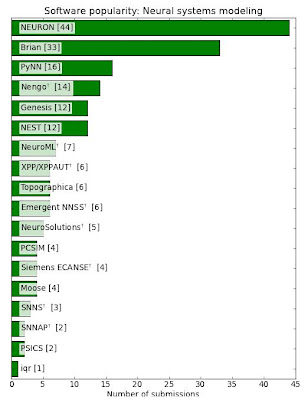

The primary analyses have been published in: Hanke, M. & Halchenko, Y. O. (2011). Neuroscience runs on GNU/Linux. Frontiers in Neuroinformatics, 5:8.
I picked several figures from their result according to my research interests:


Thursday, June 23, 2011
ICAtoolbox 3.8 is available now for download
Previously, in my homepage I only provided the content file of the toolbox, and I promised that once I translated the code descriptions into English, I would release it. However, since 2009 when I switched my interest to sparse signal recovery/compressed sensing, I had no time to do the translation job. So I decide to release it now and I apologize for some codes with descriptions/comments written in Chinese. However, if some body has questions, feel free to contact me.
The toolbox can be found in my software page: http://dsp.ucsd.edu/~zhilin/Software.html
PS: Please note that there may be several algorithm codes written by other people. The authors' names are written in the code descriptions.
The toolbox can be found in my software page: http://dsp.ucsd.edu/~zhilin/Software.html
PS: Please note that there may be several algorithm codes written by other people. The authors' names are written in the code descriptions.
You can call me "Zorro" instead of "Zhilin" if you like
During my study in US, I find many people don't know how to pronounce my first name "Zhilin", or have difficulty to remember my name. So I decide to give myself a nickname such that people can easily remember or pronounce it. And I choose "Zorro" as my nickname, since I very like Zorro during my childhood and my wife said that I have several obvious characteristics in common with Zorro (except that I don't know how to fight :) ).
Open problems in Bayesian statistics
Mike Jordan wrote a report on his interesting survey on 50 statisticians by asking them what are the open problems in Bayesian statistics. Here is his report: http://members.bayesian.org/sites/default/files/fm/bulletins/1103.pdf
The top open problems in his report are as follows:
No.1. Model selection and hypothesis testing.
No.2. Computation and statistics.
No.3. Bayesian/frequentist relationships
No.4. Priors
No.5. Nonparametrics and semiparametrics
Andew Gelman made excellent comments on these problems. Here is the link: http://statisticsforum.wordpress.com/2011/04/28/what-are-the-open-problems-in-bayesian-statistics/
The top open problems in his report are as follows:
No.1. Model selection and hypothesis testing.
No.2. Computation and statistics.
No.3. Bayesian/frequentist relationships
No.4. Priors
No.5. Nonparametrics and semiparametrics
Andew Gelman made excellent comments on these problems. Here is the link: http://statisticsforum.wordpress.com/2011/04/28/what-are-the-open-problems-in-bayesian-statistics/
Wednesday, June 22, 2011
Speeding up Latent Dirichlet Allocation (LDA)
Alex has wrote a blog entry on the speed issue of LDA and released his fast LDA algorithm that performs on many computers. Here is the blog entry: http://blog.smola.org/post/6359713161/speeding-up-latent-dirichlet-allocation
In Purdue's MLSS 2011, I was lucky to attend his lectures on graphical models. I like his lectures. The only regret is that I really hope he could give more details on LDA and its variants; for example, giving a detailed development on a variant of LDA models. But I understand the time was limited. After all, the lectures serve for a seminar, not for a college class.
 (Image credit to Alex's Lecture Slides)
In Purdue's MLSS 2011, I was lucky to attend his lectures on graphical models. I like his lectures. The only regret is that I really hope he could give more details on LDA and its variants; for example, giving a detailed development on a variant of LDA models. But I understand the time was limited. After all, the lectures serve for a seminar, not for a college class.

Friday, June 17, 2011
Scientific American: How Simple Photos Could Be Used as a Test for a Conscious Machine
The latest issue of Scientific American has an article: How Simple Photos Could Be Used as a Test for a Conscious Machine by Christof Koch and Giulio Tononi (you need to access the issue to see the full-text. The website just provides you an introduction to the article). It is very interesting. If I have time this summer, I will attend the competition. In fact, I have several ideas to cheat their smart computer. But I don't want to say much right now. However, I'd to say, the picture that the authors provide (see below) is easily recognized by computer algorithms as a unreasonable picture. Their algorithm just needs to do object recognization and then do some semantic reasoning, then it can know this picture is not reasonable. So, don't be misled by the authors' picture.

(The picture's credit to Scientific American)

(The picture's credit to Scientific American)
Thursday, June 16, 2011
The T-SBL/T-MSBL paper has been revised
I just uploaded the revised version of the paper "Sparse Signal Recovery with Temporally Correlated Source Vectors Using Sparse Bayesian Learning" accepted by IEEE Journal of Selected Topics in Signal Processing. Several errors in the local analysis have been corrected. This is the final version of the paper.
Saturday, June 11, 2011
Misunderstandings on Sparse Bayesian Learning (SBL) for Compressed Sensing (2)
I realized that I've almost forgot to continue this topic. Well, let's continue now. Particularly, I want to put more words on the regularization parameter lambda.
In the first blog entry of this topic (see Misunderstandings on Sparse Bayesian Learning (SBL) for Compressed Sensing (1)), I emphasized that
(1) for a given SBL algorithm, the optimal lambda is different under different experiment settings.
(2) Different SBL algorithms have different optimal lambda under the same experiment settings.
(3) For most SBL algorithms, noise variance is not the optimal lambda value.
Now I'll talk somethings on the lambda learning rules. Generally, most SBL algorithms have their own learning rules for lambda. However, as I emphasized previously, these learning rules basically cannot lead to the best performance for their associated SBL algorithms. To give a clear understanding on this, I'll show you a simulation result below.
The simulation is a comparison of 4 SBL algorithms for the SMV model (single measurement vector case) in a noisy environment (noise variance = 0.01). The 4 SBL algorithms are as follows:
(1) Wipf & Rao's EM-SBL (published in IEEE TSP, 2004, title: Sparse Bayesian Learning for Basis Selection) using the basic EM updating rule, denoted by EM-SBL
(2) Qiu & Dogandzic's SBL (published in IEEE TSP, 2010, title: Variance-component based sparse signal reconstruction and model selection), denoted by ExCov
(3) Ji, Xue & Carin's Bayesian Compressive Sensing (published in IEEE TSP, 2008, title: Bayesian Compressive Sensing), denoted by BCS
(4) My T-MSBL for the SINGLE measurement vector model (accepted by IEEE Journal of Selected Topics in Signal Processing, 2011, title: Sparse Signal Recovery with Temporally Correlated Source Vectors Using Sparse Bayesian Learning), denoted by T-MSBL for SMV. Although T-MSBL is derived for the MMV cases, it can be also used for SMV cases. In these cases, T-MSBL is essentially the same as EM-SBL, but T-MSBL uses an efficient learning rule for the lambda.
First, let's see how the lambda value affects their recovery performance. I plotted their performance as a function of the lambda (Note in SMV cases, EM-SBL and T-MSBL have the same performance curve as a function of lambda), i.e. all the algorithms estimated the solution when fed with a fixed lambda value, and the lambda value varied from 0.001 to 0.33. The performance curve of EM-SBL (T-MSBL for SMV), ExCov, and BCS are plotted as a red solid line, a blue solid line, and a green solid line, respectively, in the following figure.
 As we can see, if we can obtain the optimal lambda for each algorithm, then EM-SBL(T-MSBL for SMV) and ExCov have the similar performance, while BCS has the poorest performance. However, if we choose a wrong lambda, say lambda = 0.0381 (this value was calculated according to the suggestion in the Basis Pursuit Denoising paper), then we may conclude that the performance rank is: EM-SBL better than BCS better than ExCov. But if we choose lambda = 0.0042 (this value was calculated according to the suggestion in the BCS code), then we may conclude that the performance rank is: ExCov better than EM-SBL better than BCS. So, unthoughtful choices of lambda may lead to wrong conclusions. Again, we've seen the noise variance (0.01) is not the optimal lambda values of all the SBL algorithms. However, it can be seen as a good estimate for the lambda for ExCov in this case.
Second, let's see the how lambda learning rules affect the recovery performance. In fact, if we use lambda learning rules to estimate the lambda, we can find the conclusion on performance comparison will change again. I plotted the performance of EM-SBL, ExCov, and my T-MSBL when they used their own lambda leaning rules, shown in red dashed line with square marks, blue dashed line with circle marks, and red dashed line with star marks (for clear display, I omitted the performance of BCS in this case).
You can see, the lambda learning rule of EM-SBL leads to very very poor performance, so poor that even a random guess on lambda may leads to better performance. I've said that in SMV cases the only difference between EM-SBL and T-MSBL is basically the lambda learning rules. Now you can see, the lambda learning rule of my T-MSBL leads to the best performance among the algorithms.
When I read papers in the past one year, I did find that some people heavily relied on the lambda learning rules of SBL. An obvious example is, in terms of recovery performance, SBL algorithms are much better than Lasso, Basis Pursuit, Matching Pursuit etc (this is basically a "truth" well known in our lab). However, in some published simulation results, we found SBL had poorer performance than those algorithms. This is probably due to wrong choices of lambda values, or the use of some lambda learning rules that behaved very poorly.
Here I used the same experiment settings as above to compare the SBL algorithm with Lasso (fed with the optimal regularization value) and Subspace Pursuit (fed with the true number of nonzero elements in the solution vector). Lasso and Subspace Pursuit are plotted as black line with different marks in the following figure:
 Clearly, if we allow EM-SBL to use its lambda learning rule, its performance is poorer than Lasso and Subspace Pursuit. However, EM-SBL actually has much better performance than Lasso and Subspace Pursuit, if it uses its optimal lambda value, or uses the noise variance as its lambda value, or uses other lambda values obtained from cross-validation etc.
So, the lambda learning rule is also a crucial factor when evaluating a SBL algorithm's performance. All the lambda learning rules cannot lead to the best performance for their associated SBL algorithms. But some are more effective than others.
Another conclusion is, the work to derive a more effective lambda learning rule is the same valuable as the work to derive a new SBL algorithm using other computation frameworks or models. For example, ExCov is actually an extension of EM-SBL, which treats the nonzero elements of large variance and small variance with different ways. Due to this, the performance curve of ExCov as a function of lambda values is different to that of EM-SBL. When both algorithms choose their optimal lambda value, ExCov has slightly better performance than EM-SBL. However, if both algorithms use their lambda learning rules, ExCov has much better performance than EM-SBL. But if EM-SBL uses the lambda learning rule of T-MSBL (again, note that EM-SBL and T-MSBL is basically the same in SMV cases, except the lambda learning rules), EM-SBL can have better performance than ExCov (see the performance curve denoted by T-MSBL for SMV case). In this sense, it may be better to derive an effective lambda learning rule based on old models than to derive algorithms based on new models.
Actually, lambda learning rules are more important for SBL algorithms in practical applications. This is because in practice, you cannot obtain the optimal lambda value. Although you can use cross-validation, modified L-curve methods or other methods to choose a value for the lambda, for a large-scale dataset, the computational load is heavy.
In simulations you may find some algorithms exhibit excellent performance when use the noise variance as the lambda values, while others behave poorly when use the noise variance as their lambda values. If you conclude that the former algorithms should be better than the latter, you are wrong. This is because it is difficult to accurately estimate the noise variance in practical applications in most cases; errors in estimating the noise variance cannot be avoided. And you should note that the optimal lambda values of SBL algorithms are not far from each other, and not far from the true noise variance. So, the conclusion you get in simulations when use the true noise variance as the lambda values can be totally different to the conclusion you get in practice when you use the estimated noise variance as the lambda values.
In the next blog entry, I will discuss the issue on the threshold to prune out small gamma_i.
For reproducibility, the experiment settings are as follows:
Gaussian random dictionary matrix of the size 30 x 80
nonzero element number: D = 5
The nonzero elements are generated as: nonzeroW = sign(randn(D,1)).* ( rand(D,1)*0.5 + 0.5 );
And their locations are chosen randomly.
noise variance: 0.01
Reference:
Zhilin Zhang, Bhaskar D. Rao, Clarify Some Issues on the Sparse Bayesian Learning for Sparse Signal Recovery, Technical Report, University of California, San Diego, September, 2011
In the first blog entry of this topic (see Misunderstandings on Sparse Bayesian Learning (SBL) for Compressed Sensing (1)), I emphasized that
(1) for a given SBL algorithm, the optimal lambda is different under different experiment settings.
(2) Different SBL algorithms have different optimal lambda under the same experiment settings.
(3) For most SBL algorithms, noise variance is not the optimal lambda value.
Now I'll talk somethings on the lambda learning rules. Generally, most SBL algorithms have their own learning rules for lambda. However, as I emphasized previously, these learning rules basically cannot lead to the best performance for their associated SBL algorithms. To give a clear understanding on this, I'll show you a simulation result below.
The simulation is a comparison of 4 SBL algorithms for the SMV model (single measurement vector case) in a noisy environment (noise variance = 0.01). The 4 SBL algorithms are as follows:
(1) Wipf & Rao's EM-SBL (published in IEEE TSP, 2004, title: Sparse Bayesian Learning for Basis Selection) using the basic EM updating rule, denoted by EM-SBL
(2) Qiu & Dogandzic's SBL (published in IEEE TSP, 2010, title: Variance-component based sparse signal reconstruction and model selection), denoted by ExCov
(3) Ji, Xue & Carin's Bayesian Compressive Sensing (published in IEEE TSP, 2008, title: Bayesian Compressive Sensing), denoted by BCS
(4) My T-MSBL for the SINGLE measurement vector model (accepted by IEEE Journal of Selected Topics in Signal Processing, 2011, title: Sparse Signal Recovery with Temporally Correlated Source Vectors Using Sparse Bayesian Learning), denoted by T-MSBL for SMV. Although T-MSBL is derived for the MMV cases, it can be also used for SMV cases. In these cases, T-MSBL is essentially the same as EM-SBL, but T-MSBL uses an efficient learning rule for the lambda.
First, let's see how the lambda value affects their recovery performance. I plotted their performance as a function of the lambda (Note in SMV cases, EM-SBL and T-MSBL have the same performance curve as a function of lambda), i.e. all the algorithms estimated the solution when fed with a fixed lambda value, and the lambda value varied from 0.001 to 0.33. The performance curve of EM-SBL (T-MSBL for SMV), ExCov, and BCS are plotted as a red solid line, a blue solid line, and a green solid line, respectively, in the following figure.


Second, let's see the how lambda learning rules affect the recovery performance. In fact, if we use lambda learning rules to estimate the lambda, we can find the conclusion on performance comparison will change again. I plotted the performance of EM-SBL, ExCov, and my T-MSBL when they used their own lambda leaning rules, shown in red dashed line with square marks, blue dashed line with circle marks, and red dashed line with star marks (for clear display, I omitted the performance of BCS in this case).
You can see, the lambda learning rule of EM-SBL leads to very very poor performance, so poor that even a random guess on lambda may leads to better performance. I've said that in SMV cases the only difference between EM-SBL and T-MSBL is basically the lambda learning rules. Now you can see, the lambda learning rule of my T-MSBL leads to the best performance among the algorithms.
When I read papers in the past one year, I did find that some people heavily relied on the lambda learning rules of SBL. An obvious example is, in terms of recovery performance, SBL algorithms are much better than Lasso, Basis Pursuit, Matching Pursuit etc (this is basically a "truth" well known in our lab). However, in some published simulation results, we found SBL had poorer performance than those algorithms. This is probably due to wrong choices of lambda values, or the use of some lambda learning rules that behaved very poorly.
Here I used the same experiment settings as above to compare the SBL algorithm with Lasso (fed with the optimal regularization value) and Subspace Pursuit (fed with the true number of nonzero elements in the solution vector). Lasso and Subspace Pursuit are plotted as black line with different marks in the following figure:

So, the lambda learning rule is also a crucial factor when evaluating a SBL algorithm's performance. All the lambda learning rules cannot lead to the best performance for their associated SBL algorithms. But some are more effective than others.
Another conclusion is, the work to derive a more effective lambda learning rule is the same valuable as the work to derive a new SBL algorithm using other computation frameworks or models. For example, ExCov is actually an extension of EM-SBL, which treats the nonzero elements of large variance and small variance with different ways. Due to this, the performance curve of ExCov as a function of lambda values is different to that of EM-SBL. When both algorithms choose their optimal lambda value, ExCov has slightly better performance than EM-SBL. However, if both algorithms use their lambda learning rules, ExCov has much better performance than EM-SBL. But if EM-SBL uses the lambda learning rule of T-MSBL (again, note that EM-SBL and T-MSBL is basically the same in SMV cases, except the lambda learning rules), EM-SBL can have better performance than ExCov (see the performance curve denoted by T-MSBL for SMV case). In this sense, it may be better to derive an effective lambda learning rule based on old models than to derive algorithms based on new models.
Actually, lambda learning rules are more important for SBL algorithms in practical applications. This is because in practice, you cannot obtain the optimal lambda value. Although you can use cross-validation, modified L-curve methods or other methods to choose a value for the lambda, for a large-scale dataset, the computational load is heavy.
In simulations you may find some algorithms exhibit excellent performance when use the noise variance as the lambda values, while others behave poorly when use the noise variance as their lambda values. If you conclude that the former algorithms should be better than the latter, you are wrong. This is because it is difficult to accurately estimate the noise variance in practical applications in most cases; errors in estimating the noise variance cannot be avoided. And you should note that the optimal lambda values of SBL algorithms are not far from each other, and not far from the true noise variance. So, the conclusion you get in simulations when use the true noise variance as the lambda values can be totally different to the conclusion you get in practice when you use the estimated noise variance as the lambda values.
In the next blog entry, I will discuss the issue on the threshold to prune out small gamma_i.
For reproducibility, the experiment settings are as follows:
Gaussian random dictionary matrix of the size 30 x 80
nonzero element number: D = 5
The nonzero elements are generated as: nonzeroW = sign(randn(D,1)).* ( rand(D,1)*0.5 + 0.5 );
And their locations are chosen randomly.
noise variance: 0.01
Reference:
Zhilin Zhang, Bhaskar D. Rao, Clarify Some Issues on the Sparse Bayesian Learning for Sparse Signal Recovery, Technical Report, University of California, San Diego, September, 2011
Monday, May 23, 2011
New Versions of T-MSBL/T-SBL are Available for Download
Finally, I almost re-coded the two algorithms for convenient use. The main feature of the new versions is, for general users who don't know much about SBL and don't want to tune parameters, they just need to type the command:
X_est = TMSBL(Phi, Y); % for most noisy cases (SNR from 7-23dB)
or according to your rough guess about the SNR, type the command:
X_est = TMSBL(Phi, Y, 'noise', 'large'); % for SNR < 7dB
X_est = TMSBL(Phi, Y, 'noise', 'mild') ; % for SNR from 7-23dB
X_est = TMSBL(Phi, Y, 'noise', 'small') ; % for SNR > 23dB
X_est = TMSBL(Phi, Y, 'noise', 'no') ; % no noise
Each command uses a set of pre-defined parameter values, which probably are suitable for most compressed sensing experiments. But they may not be optimal for your specific task. For example, if the row-norms of your X are very small or very large, you may need to change the input argument 'prune_gamma'. Please read the demo files to see the experiment settings. If you want to get the best performance for your task, you can read my suggestions on tuning parameters from the cookbook: http://sccn.ucsd.edu/%7Ezhang/TSBL_cookbook.pdf. I strongly suggest everyone to read the short cookbook before using the codes.
The codes can be downloaded at: https://sites.google.com/site/researchbyzhang/t-msbl
==========================================
There are two pictures of my plants in that cookbook. Interesting, right? Just relax :)
 It is called cobra plant, because it is like a cobra :)
Another one is called N. ampullaria (red) x N. sibuyanensis. It is a nepenthes.

X_est = TMSBL(Phi, Y); % for most noisy cases (SNR from 7-23dB)
or according to your rough guess about the SNR, type the command:
X_est = TMSBL(Phi, Y, 'noise', 'large'); % for SNR < 7dB
X_est = TMSBL(Phi, Y, 'noise', 'mild') ; % for SNR from 7-23dB
X_est = TMSBL(Phi, Y, 'noise', 'small') ; % for SNR > 23dB
X_est = TMSBL(Phi, Y, 'noise', 'no') ; % no noise
Each command uses a set of pre-defined parameter values, which probably are suitable for most compressed sensing experiments. But they may not be optimal for your specific task. For example, if the row-norms of your X are very small or very large, you may need to change the input argument 'prune_gamma'. Please read the demo files to see the experiment settings. If you want to get the best performance for your task, you can read my suggestions on tuning parameters from the cookbook: http://sccn.ucsd.edu/%7Ezhang/TSBL_cookbook.pdf. I strongly suggest everyone to read the short cookbook before using the codes.
The codes can be downloaded at: https://sites.google.com/site/researchbyzhang/t-msbl
If you have any questions or suggestions, please feel free to contact me. And, if you find the codes do not perform well, please let me know.
==========================================
There are two pictures of my plants in that cookbook. Interesting, right? Just relax :)

Another one is called N. ampullaria (red) x N. sibuyanensis. It is a nepenthes.

Saturday, May 21, 2011
Codes of T-SBL and T-MSBL are under updating
I just found there are two bugs in the codes of T-SBL and T-MSBL for high SNR cases or noiseless cases. I am now correcting them. Also, I realized that probably some users dislike setting these input arguments; they want to just input the dictionary matrix Phi and the measurement data Y, then wait for the results. So, I'm trying to simplify the setting of input arguments.
Please give me one more day. I will upload the codes again in this weekend.
Please give me one more day. I will upload the codes again in this weekend.
Thursday, May 19, 2011
Life Without Limits, No Arms, No Limbs and No Worries
Today I watched a video from Youtube. It is a talk by Nick Vujicic. It's really a wonderful video. Anyone who is in depression or feel hopeless should watch this inspirational video. Anybody who has arms and legs has no reason to give up in life.
He has a book titled :

He has a book titled :
Life Without Limits: Inspiration for a Ridiculously Good Life
can be bought from Amazon. DVD is also available at Amazon.Codes of T-SBL and T-MSBL are available
I have posted the codes of T-SBL and T-MSBL on my homepage, which are developed in my paper:
Zhilin Zhang, Bhaskar D. Rao, Sparse Signal Recovery with Temporally Correlated Source Vectors Using Sparse Bayesian Learning, IEEE Journal of Selected Topics in Signal Processing, Special Issue on Adaptive Sparse Representation of Data and Applications in Signal and Image Processing, 2011, accepted.
They can be downloaded from here. But before you running/testing the codes, I strongly suggest you spend 3 minutes in reading the short cookbook on how to set suitable input parameters. There are four study cases, such as noiseless case, mild noisy case, strongly noisy case, and so on. You can check the example in each case for advice on choosing parameters. But don't be scared. Generally, in any case you only need to set 1 or 2 parameters, and setting them is a piece of cake (you do not need to understand SBL or read any SBL paper!)
Along with the codes of T-SBL and T-MSBL, there are several demos, which can re-produce the experiment results in my paper.
The paper has been revised. But it is still not the final version. I am now revising the language :( The final version will be uploaded at the end of this month).
Also, I've uploaded the code of M-SBL. It can be downloaded from here. Yes, David has a code of M-SBL. But his code is not suitable for noisy cases and even not suitable for noiseless case. I also suggest you to read the comments in my code to correctly use M-SBL for algorithm comparison.
Zhilin Zhang, Bhaskar D. Rao, Sparse Signal Recovery with Temporally Correlated Source Vectors Using Sparse Bayesian Learning, IEEE Journal of Selected Topics in Signal Processing, Special Issue on Adaptive Sparse Representation of Data and Applications in Signal and Image Processing, 2011, accepted.
They can be downloaded from here. But before you running/testing the codes, I strongly suggest you spend 3 minutes in reading the short cookbook on how to set suitable input parameters. There are four study cases, such as noiseless case, mild noisy case, strongly noisy case, and so on. You can check the example in each case for advice on choosing parameters. But don't be scared. Generally, in any case you only need to set 1 or 2 parameters, and setting them is a piece of cake (you do not need to understand SBL or read any SBL paper!)
Along with the codes of T-SBL and T-MSBL, there are several demos, which can re-produce the experiment results in my paper.
The paper has been revised. But it is still not the final version. I am now revising the language :( The final version will be uploaded at the end of this month).
Also, I've uploaded the code of M-SBL. It can be downloaded from here. Yes, David has a code of M-SBL. But his code is not suitable for noisy cases and even not suitable for noiseless case. I also suggest you to read the comments in my code to correctly use M-SBL for algorithm comparison.
Subscribe to:
Posts (Atom)